
Country profiles on health, Hannah Ritchie wins the Unwin Award, who Americans spend time with, and more
A twice-monthly digest of our latest work plus curated highlights from across Our World in Data.


Welcome to The OWID Brief! In this edition we cover:
Our new country profiles on health for every country in the world
Low-carbon electricity sources grew faster than demand in 2025, pushing fossil fuels into decline
… and more.
🆕 OUR RECENT PUBLICATIONS AND UPDATES
Explore the interactive version of this chart →
Explore key health metrics for your country
We’ve published new country profiles on health for every country in the world.
Each profile tells the story of a single country: how long people typically live, what they die from, what progress is being made against major diseases and risk factors, what share of children receive key vaccinations, and much more — all in one place.
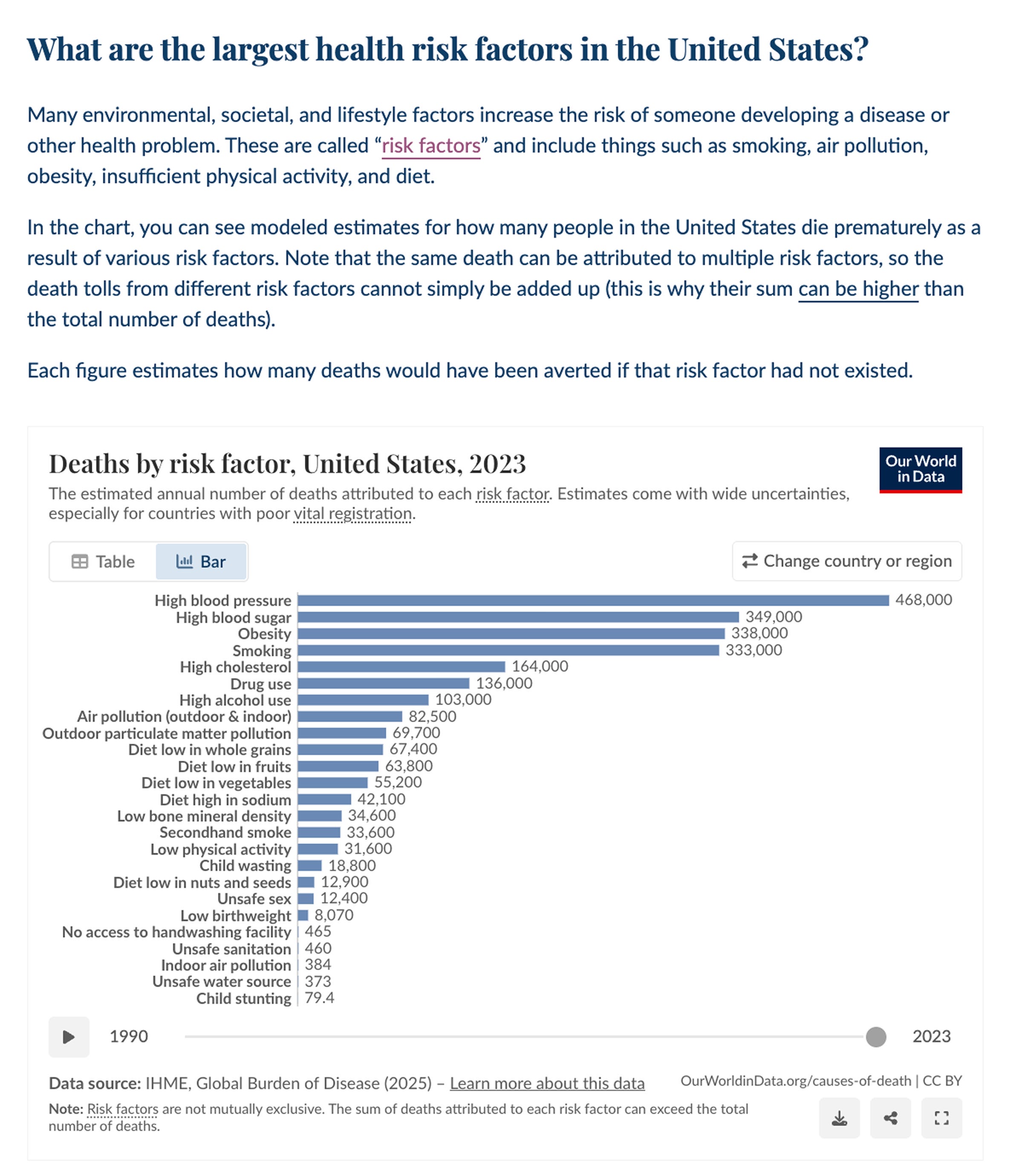
The image here is a snippet from the United States’ profile. It shows estimates for how many people die prematurely as a result of various risk factors, such as high blood pressure, obesity, and smoking.
Many charts in each profile automatically include comparisons to other countries — for example, in the same geographic region or at a similar income level — so you can understand each country in context.

Hannah Ritchie, our Deputy Editor and Science Outreach Lead, has won the 2026 Unwin Award!
The award recognizes “non-fiction writers in the earlier stages of their careers as authors, whose work is considered to have made a significant contribution to the world.”
It’s awarded for an author’s overall body of work. Hannah has written two books:
Clearing the Air: A Hopeful Guide to Solving Climate Change in 50 Questions and Answers
Not the End of the World: Surprising facts, dangerous myths and hopeful solutions for our future on planet Earth
The award’s judging panel praised Not the End of the World as “a well-written and revealing book and for its optimistic and data-grounded approach which gives readers hope for the future of the planet.”
The award comes with a £10,000 prize, which Hannah decided to donate to the Against Malaria Foundation.
Congratulations, Hannah!
📈 DATA INSIGHTS
Bite-sized insights on the world and how it’s changing
Since our last OWID Brief, we’ve published insights across various topics. Here’s a selection:
Low-carbon electricity sources grew faster than demand in 2025, pushing fossil fuels into decline →
Which countries have fertility rates above or below the “replacement level”? →
India went from 15% to 70% Internet access in a decade, mostly through mobile phones →
Subscribe to our Data Insights newsletter
Our dedicated Data Insights newsletter delivers new insights right to your inbox every few days.
🌟 EXPLORE OUR FEATURED WORK
Explore the interactive version of this chart →
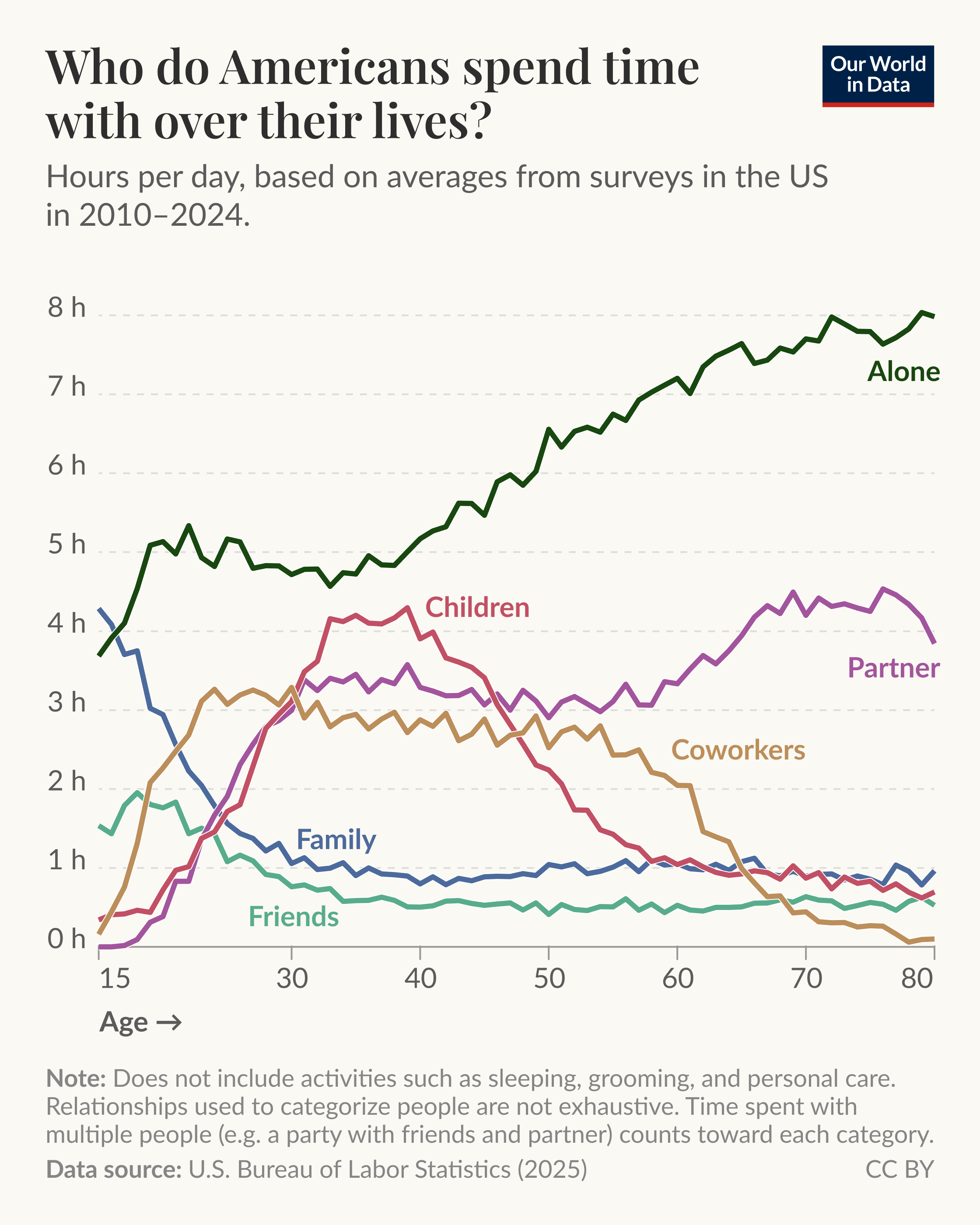
Who Americans spend their time with changes a lot over the course of their lives.
In their teens, Americans spend a lot of time with friends and family.
In their 20s, time with friends and family starts to drop off. Instead, Americans begin to spend more time with partners and children.
Throughout their 30s, 40s, and 50s, Americans spend much of their time with coworkers.
As they get older, Americans spend more time alone, but surveys show this doesn’t necessarily mean they’re lonely.
This data comes from the American Time Use Survey, conducted by the U.S. Bureau of Labor Statistics. Our colleague Tuna Acisu recently updated our charts with the latest data release.
From our classics
📖 WHAT WE’VE BEEN READING

The economics of population decline in China
“Will China get richer before it gets much, much smaller?” asks Toby Nangle in a recent Financial Times article.
Nangle highlights several trends from the UN Population Division’s “medium variant” projections over the next century.
According to these, China’s working-age population (aged 20–69) will shrink by two-thirds by 2100, from nearly a billion to around 300 million.
Today, China has more than four times as many working-age people as the US. By 2100, the gap would nearly vanish.
If China’s rise has been the defining economic story of recent decades, Nangle argues, its demographic decline could have similarly large consequences.
Nangle does caution that these projections should be taken “with a pinch of salt”: long-run forecasts are notoriously difficult, and the medium variant is just one of several scenarios the UN offers, each with its own assumptions.
– Bertha

How safe are self-driving cars?
This question is becoming more pressing as robotaxi companies, especially Waymo, rapidly scale up their distance driven on public roads.
Kai Williams and Timothy B. Lee of Understanding AI worked through dozens of Waymo crash reports in the US.
Their review is consistent with the company’s own safety reports. Waymo estimates that, compared to human drivers in the same cities, its vehicles get into 82% fewer injury-causing crashes.
The authors zoomed in on 78 crashes involving an injury or airbag deployment, over an estimated 100 million miles of self-driving.
Most crashes were caused by other, human drivers — often rear-ending a stopped Waymo — though there were also clear ways Waymo could improve.
When the car did make a mistake, the authors write, it was almost always one of “excessive caution”.
They also highlight how other robotaxi companies — Tesla, Zoox, May Mobility — have smaller fleets and are less transparent about their safety data, making it harder to analyze their records.
– Charlie
The mission of Our World in Data is to increase understanding of the world’s largest problems and drive informed action to solve them.
We are a nonprofit, building Our World in Data as a public good that’s freely available to everyone. Help us do more by supporting us with a donation.