
Migration data tool, natural disasters, measles vaccines, and more
A twice-monthly digest of our latest work plus curated highlights from across Our World in Data.


Welcome to The OWID Brief! In this edition we cover:
… and more. Check it out! ⬇️
🆕 OUR RECENT PUBLICATIONS AND UPDATES
An interactive tool that helps us see where migrants were born and where they live now
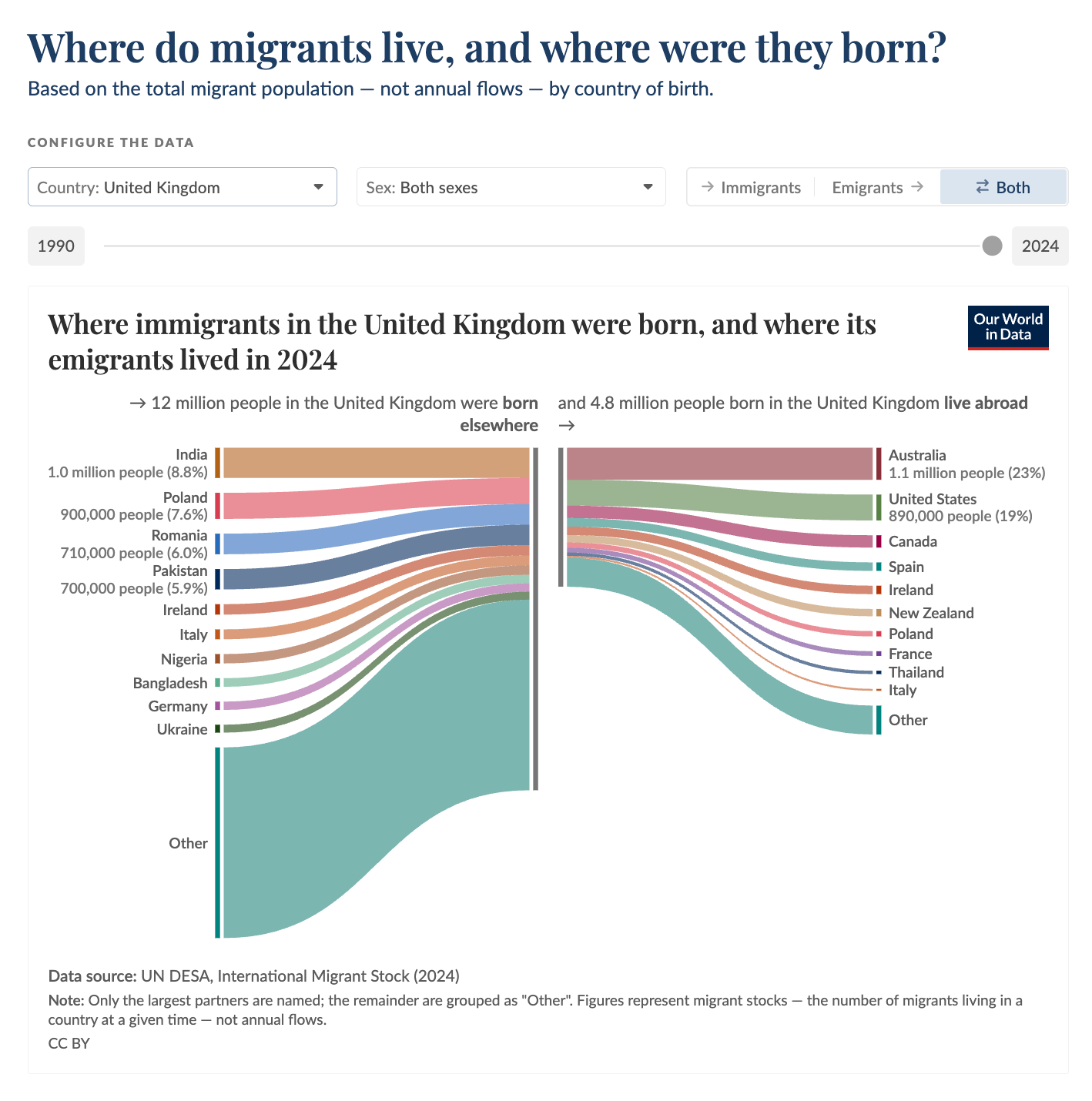
In 2024, around 280 million people lived in a different country from the one in which they were born. That’s around 3.5% of the global population.
Where were these international migrants born, and where did they move to?
Our colleague Sophia Mersmann built a new interactive tool that lets you answer these questions — for any country you’re interested in.
On the left-hand side of the visualization, you can see the total number of people living in the UK who were born elsewhere, and where they were born.
On the right-hand side, you can see the number of people born in the UK who have moved away, and where they moved to.
If you want to dig deeper, there are a few other ways you can explore the data:
Use the time slider to see how things have changed over time
Break it down by sex to see where men or women are moving
Click on “immigrants” or “emigrants” to focus only on those views of the data
Explore the interactive version of this chart →
A new page bringing together our data and writing on natural disasters
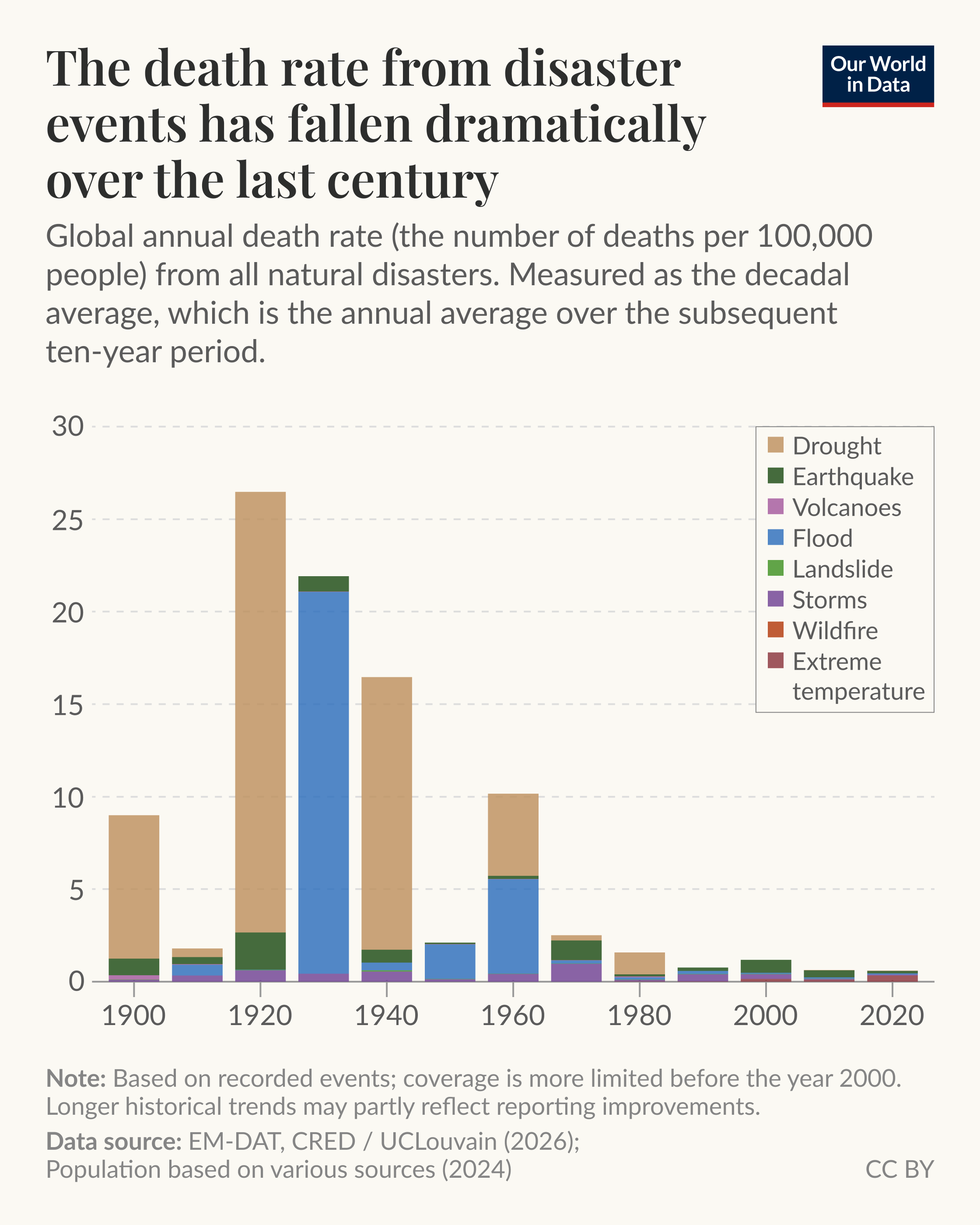
The world has become much more resilient to disaster events over the last century.
In the chart here, you can see estimates of average death rates — measured as the number of deaths per 100,000 people — by decade since the early 20th century.
Over the last century, death rates have fallen by more than 90%.
Records from a century ago are much less complete, with many small and medium-sized events missed, so this may even be an underestimate.
This is not because hazards have become weaker. It’s because societies have become more resilient:
Weather forecasting has allowed us to know when disasters are coming ahead of time, giving societies time to prepare.
Early warning systems allow local populations to take cover and stay safe.
Better buildings can withstand earthquakes and hurricanes.
National and international cooperation, combined with transport and trade, means others can provide assistance when a disaster does strike.
Food systems are more productive and better connected, making the impact of a lost harvest less severe than it would have been a century ago.
Continuing to improve the resilience of systems worldwide remains crucial to reducing the toll from disasters in the future.
📈 DATA INSIGHTS
Bite-sized insights on the world and how it’s changing
Since our last OWID Brief, we’ve published insights across various topics. Here’s a selection:
What is the largest source of electricity in each country? →
Australia is replacing coal and gas power with solar and wind →
Spain and Portugal both get over 40% of their electricity from solar and wind →
Just over one-third of the world’s assessed fish stocks are overexploited →
NVIDIA’s revenue from data centers and AI has grown 1,300-fold in the last 12 years →
Subscribe to our Data Insights newsletter
Our dedicated Data Insights newsletter delivers new insights right to your inbox every few days.
🌟 EXPLORE OUR FEATURED WORK
Measles vaccines save millions of lives each year
Measles used to be an extremely common disease.
Just sixty years ago, over 90% of children would have been infected by it, and of those who developed symptoms, around a quarter would be hospitalized.
The United States alone had around three to four million cases annually, leading to tens of thousands of hospitalizations and hundreds of deaths each year. In some countries, these numbers were much higher.
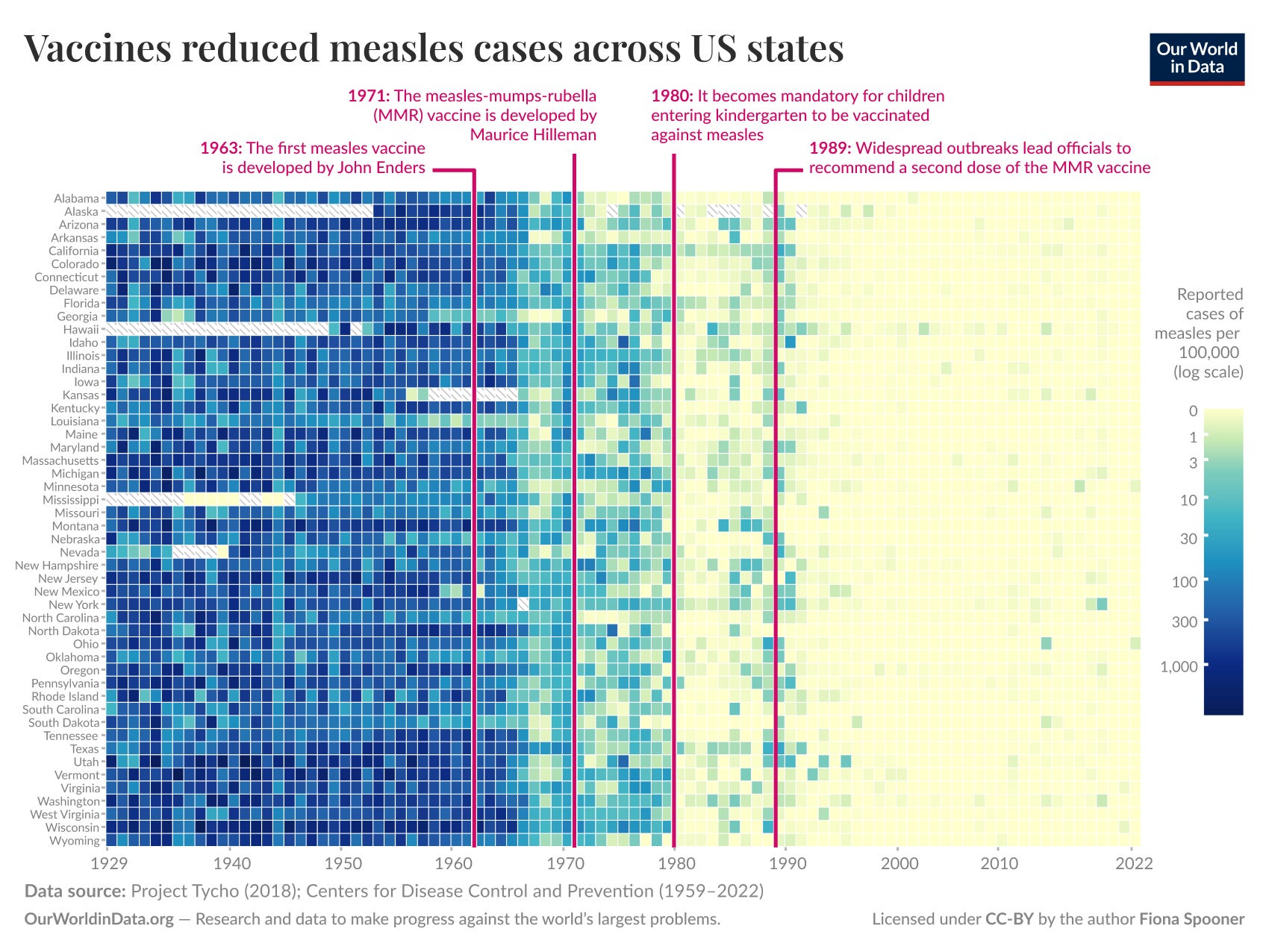
However, in 1963, John Enders developed the first effective measles vaccine. Vaccination efforts ramped up rapidly in richer countries — you can see this for the US in the chart.
Throughout the 1970s and 1980s, these efforts were scaled up worldwide.
In just the last fifty years, it’s estimated that measles vaccinations have prevented over ninety million deaths worldwide.
Two to three million people would die from measles every year without them. This means these vaccines are likely the most life-saving ones currently in use.
From our classics
📖 WHAT WE’VE BEEN READING
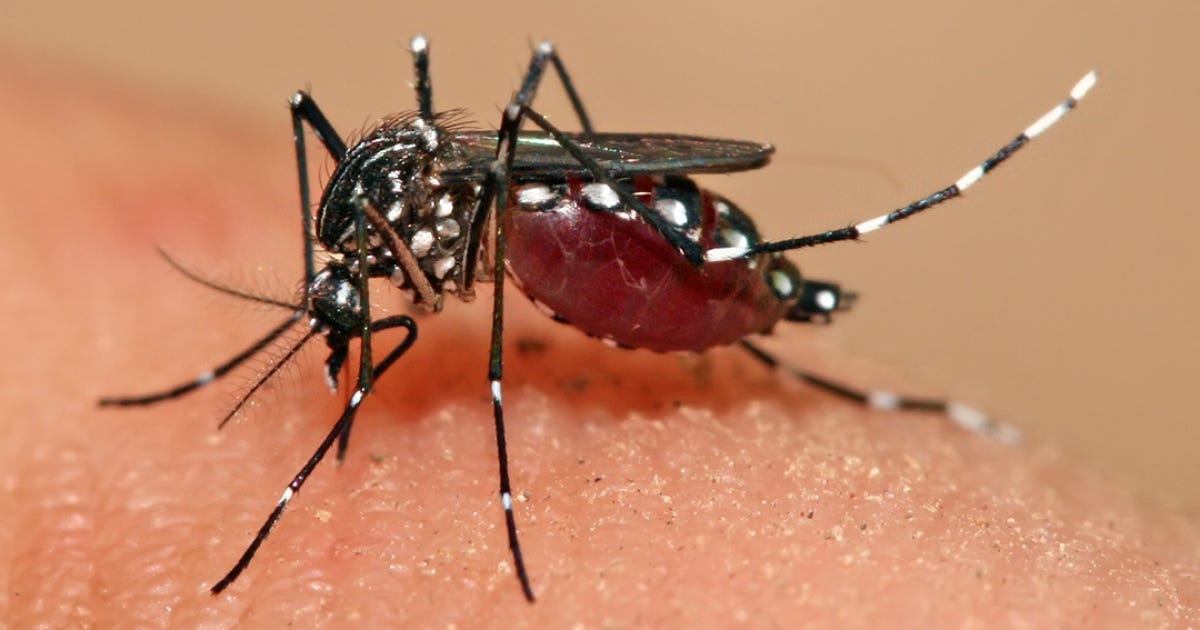
Fighting mosquitoes with mosquitoes
Mosquitoes transmit terrible diseases like malaria, dengue, yellow fever, and more. They bite and infect people, killing an estimated 760,000 each year — more than any other animal.
Debug, a Google project, aims to drastically reduce the number of disease-carrying mosquitoes.
They’re scaling up an approach that's already shown promise: using a naturally occurring bacterium called Wolbachia to sterilize male mosquitoes.
These sterile males are then released into the wild to mate with females whose eggs never hatch, shrinking the mosquito population over a few generations.
There's another promising way to use Wolbachia: my colleague Hannah has written about how it can stop mosquitoes from transmitting viruses, rather than sterilizing them.
The Guardian recently reported that US regulators are reviewing an application from Debug to release up to 32 million sterile male mosquitoes across California and Florida.
If these efforts scale, it could be a meaningful step in the fight against mosquito-borne illness.
– Bertha
What’s the role of AI in science?
A new generation of AI “co-scientists” is getting better at more aspects of the scientific process, from scouring the research literature to designing experiments and analyzing the results.
An editorial in the scientific journal Nature argues that such systems should empower human researchers, not replace them.
It points to two recent studies published in the same journal: one AI system, from the nonprofit lab FutureHouse, proposed a candidate drug for an eye disease.
Another system, from Google, reached the same hypothesis about antibiotic resistance that scientists had spent about a decade pursuing — but within days.
These results are striking. But in both, humans still played a central role: they framed the projects, ran the experiments, and vetted the output for errors and fabrications.
The editorial argues that human judgment, and the wisdom that teams build over years, can’t easily be replicated by machines.
AI may bring more efficiency, it notes, but “we don’t yet know whether greater efficiency equates to greater insight”.
– Bobbie
The mission of Our World in Data is to increase understanding of the world’s largest problems and drive informed action to solve them.
We are a nonprofit, building Our World in Data as a public good that’s freely available to everyone. Help us do more by supporting us with a donation.